August 25, 2025


News broke on Sunday morning, and my mind instantly went back to Jaipur. We had landed on the evening of the 20th, greeted by gusty winds, lightning, and rain. Curious, we asked our Uber driver if it had been raining for days. He laughed: “No, not for many days. Thanks for coming with the rains—you arrived, and it rained.”
Over the next two days, during our visits to nearby villages, the same conversation kept coming up. Many joked that when it didn’t rain, they would call this “Mumbai party” to bring the clouds along. Yet what we saw during our village visits was striking. Compared to Mumbai’s heavy monsoon downpours, this rain was light—but still caused widespread waterlogging. Cemented roads and rerouted natural canals had drastically reduced the land’s ability to absorb water. We were there working on a project about drinking water access, and locals repeatedly emphasized the value of rainwater and the need for storage.
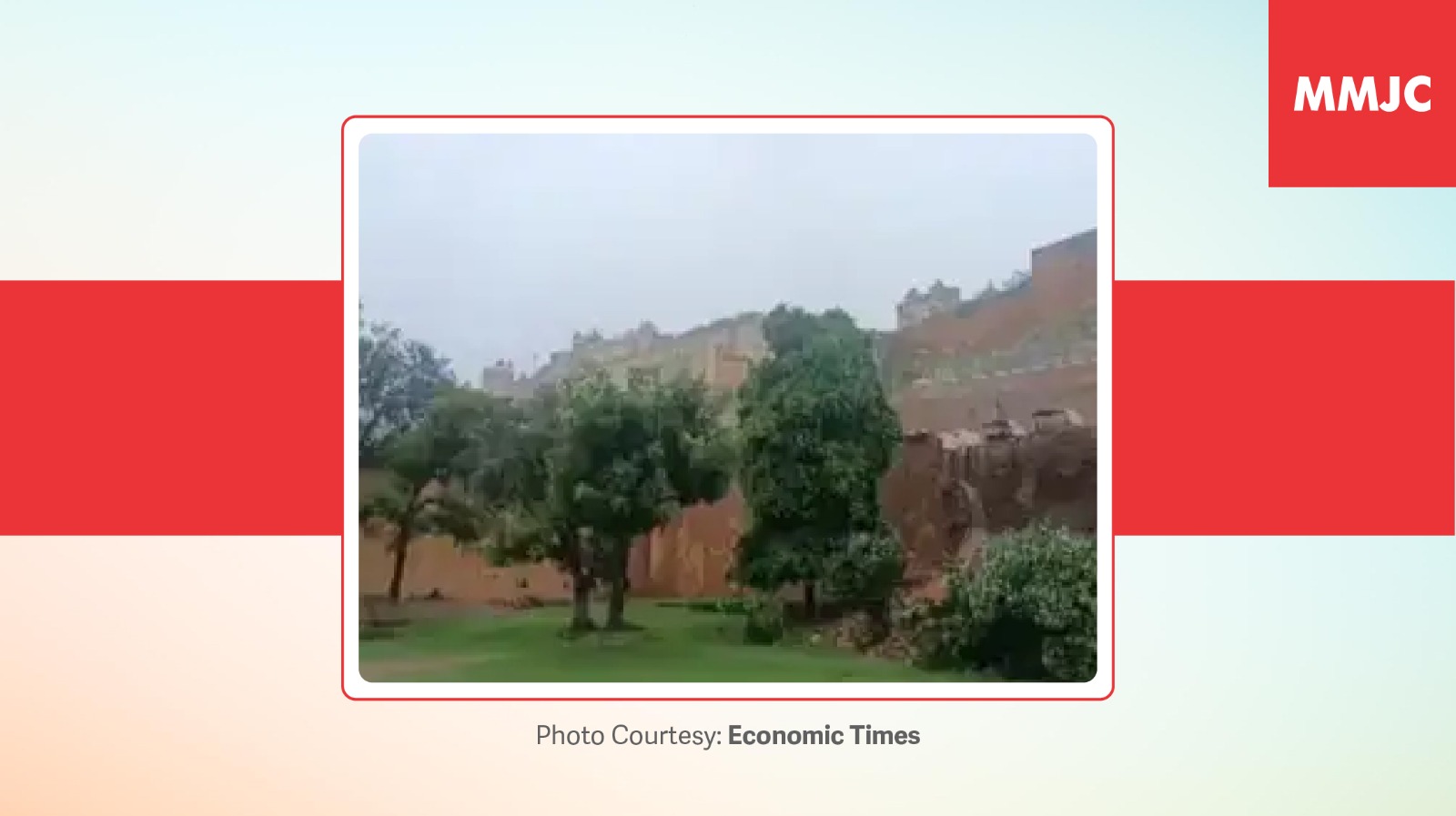
We came back on Saturday. The very next day, news broke: “a section of Amer Fort’s outer wall—called the Rambagh wall in front of Jwala Mata Temple—had collapsed after heavy rains hit Jaipur. A 200-foot stretch crumbled, turning centuries-old stonework into rubble.”
What an irony: rain was a blessing for some but brought destruction for others.
Walking through Jaipur, I felt how monuments and historic buildings make a city breathe history. They transport you centuries back, revisiting the glorious past. Cities such as Kolkata, Varanasi, Jaipur, Mumbai’s Fort Area, and Pune’s Mandai tell stories we often only read in books or watch in films. Sitting at Amer Fort, enjoying Rajasthani folk songs and dances while savouring daal baati churma, bajre ki roti, and gatte ki sabzi—that was an experience that blended history, culture, and flavour.
These monuments are India’s true Dharohar. They let us feel history with all our senses—seeing majestic forts, breathing in Rajasthan’s proud air, walking barefoot where great warriors once walked, touching the stones they built, and enjoying the food they once savoured. This is a living, proud walk for Indians. Heritage must be not only retold—but relived by every generation—and preserved for the world to witness.
Amer Fort, built in the 16th century by Raja Man Singh, is a UNESCO World Heritage Site. How does a site earn that status? The host country nominates it, and UNESCO’s World Heritage Committee evaluates whether it’s a unique landmark of cultural or physical importance. Once listed, protecting it becomes a legal and moral responsibility. In India, this falls to the Archaeological Survey of India (ASI) under the Ancient Monuments and Archaeological Sites and Remains (AMASR) Act, 1958, and the World Heritage Convention.
The AMASR Act is India’s primary law for safeguarding monuments over 100 years old. It ensures fencing, maintenance, controlled access, and conservation. Today, ASI protects over 3,600 monuments, managed through 38 Circles nationwide. Its work—from chemical preservation to landscape development and excavations—ensures systematic care and research.
For instance, at the Konark Sun Temple, ASI has undertaken extensive preservation—removing sand once filled to prevent collapse, cleaning and strengthening sculptures, addressing salt deposits, and replacing damaged stones with locally sourced Khondalite using traditional methods.
Aligned with UNESCO and ICCROM (International Centre for the Study of the Preservation and Restoration of Cultural Property) frameworks, preventive steps include regular structural inspections, environmental monitoring, buffer zones, and community training for disaster preparedness. In turn, response and recovery after disasters require immediate area cordoning, temporary stabilization, multi-agency coordination, and restoration guided by authenticity and traditional methods. Every recovery should strengthen resilience and feed into updated disaster management plans.
The Ministry of Culture’s “Adopt a Heritage” (and its upgraded version, “Adopt a Heritage 2.0”) scheme enables corporates, public sector entities, NGOs, and individuals to develop, maintain, and promote heritage sites using CSR funding. Introduced in 2017 and revamped in 2023, it encourages active collaboration to enhance visitor amenities at protected monuments. This initiative is especially significant considering the Ministry of Culture receives less than 1% of India’s total annual expenditure—highlighting the need for private participation in preserving the nation’s heritage
Under Schedule VII of the Companies Act, CSR activities include “(v) protection of national heritage, art, and culture, including restoration of buildings and sites of historical importance and works of art.” According to the National CSR Portal (2023−24), ₹704.04 crore was spent on art and heritage—Odisha ranked first, Maharashtra second, and Rajasthan ninth, despite hosting several UNESCO sites.
Here lies an opportunity for corporates to step up. Investing CSR funds in heritage conservation isn’t charity—it’s impactful work. It builds pride in our roots and lets younger generations connect with history directly. They can walk the same paths, touch the same stones, and experience India’s stories firsthand—not just read them.
Industry leaders can take charge. By giving back to our cultural soil, they can protect monuments like Amer Fort and ensure that India’s story continues to be lived, felt, and retold for centuries.
Investing in monuments is investing in India’s legacy.
CS Vedanti Vaidya,
Sr. Sustainability Consultant
(Volunteered for one year on ethnographic studies in North-East India)
1 Comment
You have explained the importance of our heritage and the need to preserve it in very simple words. If people truly feel it within their conscience, they will definitely reflect on your article. This heritage is not only a part of our history, but it also represents our faith and our deep love for the motherland.
Comments are closed.