September 13, 2025


Corporate Social Responsibility (CSR) is essential because it recognizes that businesses are part of a larger ecosystem where communities, the environment and the economy are interconnected. Individuals depend on their environment for growth and survival, companies too depend on healthy, resilient societies and natural systems.
CSR achieves the greatest impact when it starts with systematic stakeholder identification and curating strategies for stakeholders. Mapping and engaging key groups—such as local communities, employees and governments helps companies understand diverse needs and expectations. This approach to stakeholder management ensures CSR is not just responsive, but also strategic creating long-term value for both business and society.
Impact assessment highlights how CSR projects create change across interconnected stakeholders. It captures what improved for individuals, families, communities and institutions, and guides businesses on what worked and what can be strengthened for sustainable outcomes.
MMJC encourages the adoption of theory-driven approach to address development issues and assess the impact of CSR programmes. By viewing communities, businesses and the environment as interconnected systems, CSR teams and implementation agencies are better equipped to:
The CSR Impact Theory Series explores structured and theory-based approaches to assess, understand and enhance the real-world outcomes of CSR initiatives. The second article in this series examines CSR programs through Ecological theory, exploring how businesses can design, implement and assess initiatives by considering the interdependence, adaptation and balance of social and environmental systems.
Ecological Systems Theory
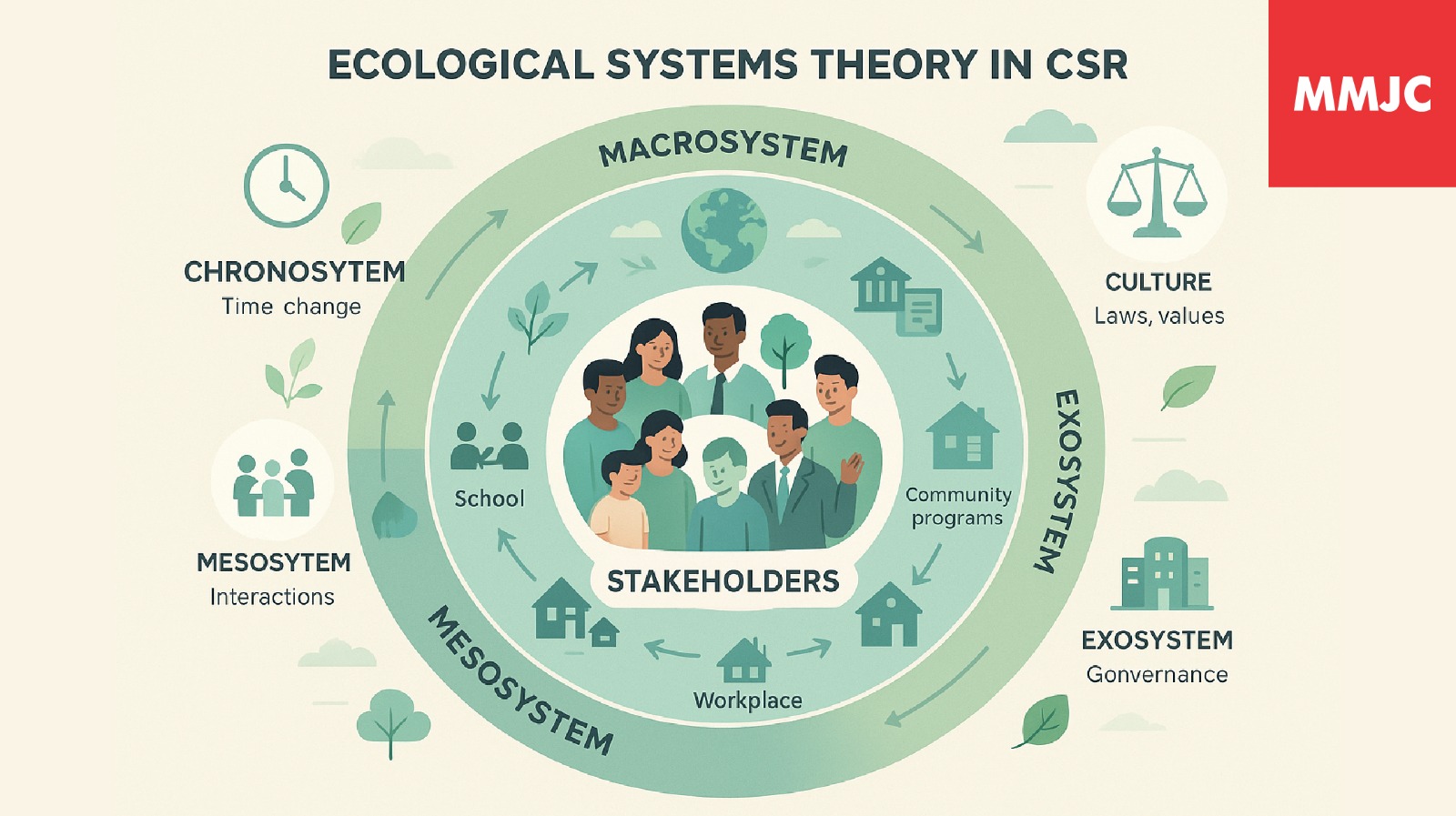
Ecological systems theory highlights how individuals are shaped by their interactions with multiple environments. Rooted in biological, psychological and social sciences, it explains how immediate surroundings such as family and community and broader societal structures, including cultural norms, laws and institutions, influence a person’s development and empowerment. In this article we are adopting and adapting Bronfenbrenner’s Ecological Systems Theory.
Bronfenbrenner’s ecological systems theory explains a person’s growth happens through ongoing interaction with different systems around them. These include the microsystem, mesosystem, exosystem, macrosystem and chronosystem.
Ecological Theory as a Guide for CSR:
Stakeholder theory highlights that businesses have responsibilities to shareholders and to all stakeholders, including employees, communities, suppliers, customers and the environment. Ecological theory, which explains how all parts of an ecosystem are interconnected and need balance to thrive, offers a valuable approach for CSR by guiding businesses to engage and manage stakeholders in a way that supports both community well-being and long-term sustainability.
Applying this perspective to CSR helps organizations understand that their actions affect the environment and also multiple stakeholder groups, including employees, communities, suppliers, customers and regulatory bodies.
Ecological theory makes CSR stronger by focusing on how everything is connected, the need for balance and the ability to adapt. It helps companies plan CSR programs that are sustainable, fair and effective. By seeing stakeholders and the environment as parts of a connected system, businesses can make sure their CSR activities benefit both people and the planet.
The article is written by Ms. Suhani Thepadiya – Consultant – Sustainability.