September 9, 2026

Across large parts of rural India, farming still depends heavily on the weather. This is especially true in tribal and remote areas that lack year-round irrigation. Families rely on four months of monsoon rain to cultivate enough crop to a earn year’s income. For the remaining eight dry months, there is little farm work available, so seasonal migration to urban centres becomes the only way to meet their financial need.
A recent field visit with the Ekalavya Foundation[i] showed how this cycle can be broken with minimum resources and careful planning. The program is a case story how even a single water source, an open well in this case, can be enough to transform an entire village.
This article traces that journey of how one tribal community in Telangana moved from rainfed, single crop agriculture to practicing sustainable multiple cropping and increase their earnings. Telangana is home to around 35 million people, with nearly 61% residing in rural areas and 9% belonging to Scheduled Tribe (ST) communities. The main tribal groups residing in the state – Gonds, Kolams, and Thotis are concentrated in the northern region—particularly the Adilabad area and the remote, hilly parts of Kumuram Bheem Asifabad. They are geographically islolated and often lack of basic infrastructure. On account of this persistent developmental gaps, Kumuram Bheem Asifabad is officially recognized as an Aspirational District under the NITI Aayog program[i].
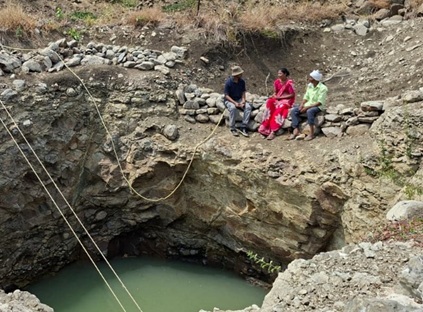
The project was implemented to address water scarcity and single-season farming in the area. Earlier, farmers were dependent only on monsoon and could take only one crop, which resulted in low income and seasonal migration. To fix this problem, a Scientific Hydrogeological Assessment was conducted to identify groundwater potential and sub-surface strata. Based on the assessment, open wells were constructed / rejuvenated to ensure assured water availability.
Farmers broke free from vicious cycle of debt and poverty, A New Sense of Self-Respect:
Low and unpredictable incomes forced farmers to borrow informal sources at high interest rates, for seeds, fertilisers, and household expenses. Nearly all of their harvest earnings disappeared in loan repayment, trapping them in a cycle of debt that was hard to escape.
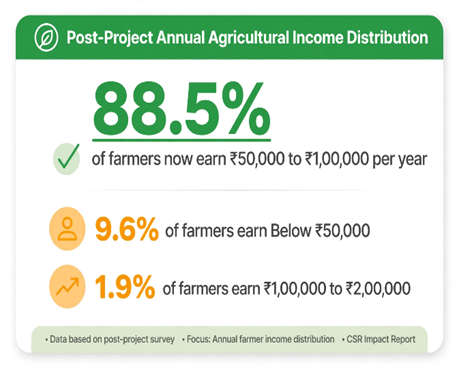
With reliable water availability all year round and the higher income, farmers have become self-reliant. They no longer borrow money, and many now buy their own seeds with their own earnings, reflecting financial self-reliance, and for the community, this shift in confidence is perhaps the project’s greatest victory. Shri Ganesh (name changed), a tribal farmer met during the visit, informed me that he was able to experiment with multiple crops after irrigation water became available throughout the year. The average income in the village has risen from 30,000 p.a. to 50,000 p.a. Some farmers were able to increase their income to as much as 2,00,000 p.a.
The Turning Point: An Open Well Built with CSR Support:
A few years ago, tribal farmers in the region barely earned ₹20,000 to ₹30,000 a year. Once the monsoon ended, the fields dried up, and farmers could do little but wait and hope for the next monsoon season.
The program changed this completely. This sustainable transformation was enabled through a structured, community-centric field implementation process:
Farmers’ Club: Experimenting with Multiple cropping:
Once water became available, the next step was to change how farming itself was done. With modern agricultural techniques guidance from project implementing NGO and farm, a ‘Farmers’ Club’ was formed in the village. Through this club, farmers learned multiple cropping — growing several crops and vegetables together on the same land. Today, they cultivate a mix of leafy greens, fruit-bearing vegetables, and cash crops alongside their main crop. This improved soil fertility and given farmers enough produce to sell in the market throughout the year, creating a steady flow of income rather than a single seasonal payout.
| Key Benefits Reported by 200 Farmers Under Family Economic Stability and Multiple Cropping |
| Increased Income from Second Crop ……….. 77.8% |
| Vegetable Cultivation for Sale & Household … 11.1% |
| Livestock Water & Fodder Access ………….. 5.6% |
| Enhanced Household Food Security …………. 5.5% |
Laxmi’s story: Better Education for Children, Better Care for Animals:
Life before: “We have cows and bulls at home and looking after them was very tough. From March to May, there was no green grass near our farm, so we had to walk long distances just to find water and food for our animals. On our land, we could grow only one crop a year, since we had no water source. We always struggled with money, and we had to think twice before spending even a single rupee on our children.”
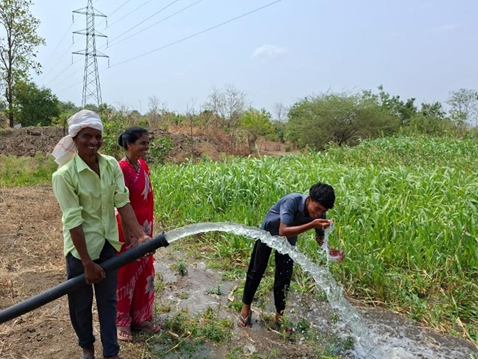
Life now: “Ever since we got support for the open well, our life has completely changed. Now, my cows and bulls get fresh green grass and clean water right at our farm every day — I don’t have to walk far anymore. Thanks to Ekalavya, I have safely started growing two crops a year. Our farm profits have increased, and with this extra money, I can easily pay for my children’s education. As a parent, the best feeling is that I no longer have to think twice whenever my children ask for their school things or small treats.”
A small step can also lead to long-term change:
With water now available directly in the fields, cattle get fresh fodder and clean drinking water right where they are. Farmers no longer need to walk their animals’ long distances in search of grazing land.
This project shows that rural and tribal development doesn’t always need massive funding, it needs the right resources and training, delivered in the right places. A single well has not only moistened dry land but has also eased the hardships of thousands of tribal farmers, allowing their dreams of a more prosperous life to take root. It stands today as a model study for CSR initiatives and social organisations alike.
The Article is authored by Mr. Varun Phansekar – CSR and BRSR Team!
Photo Credit: MMJC | Field Visit – MMJC Team
[ii] The Aspirational Districts Programme (ADP), launched by NITI Aayog in 2018, aims to rapidly transform 112 of India’s most underdeveloped districts by focusing on health, education, agriculture, financial inclusion, and basic infrastructure. https://www.niti.gov.in/sites/default/files/2022-09/List-of-Aspirational-Districts.pdf