December 22, 2025


Role of Corporates in the Transition from a Linear to a Circular Economy
Climate change refers to long-term changes in global temperatures and weather patterns, mainly caused by human activities such as burning fossil fuels, deforestation, and industrial emissions. These activities increase greenhouse gases in the atmosphere, leading to rising temperatures, extreme weather events, melting ice caps, sea-level rise, and significant impacts on health, agriculture, and livelihoods.
To address these growing threats, countries meet every year at the United Nations Climate Change Conference, known as COP (Conference of the Parties). While the COP drives action at the global level, the upcoming Mumbai Climate Week (MCW), brings climate action closer to people by focusing on food systems, energy transition, and urban resilience. As India’s first citizen-led climate event, the MCW serves as a bridge between global climate commitments and local, practical solutions.
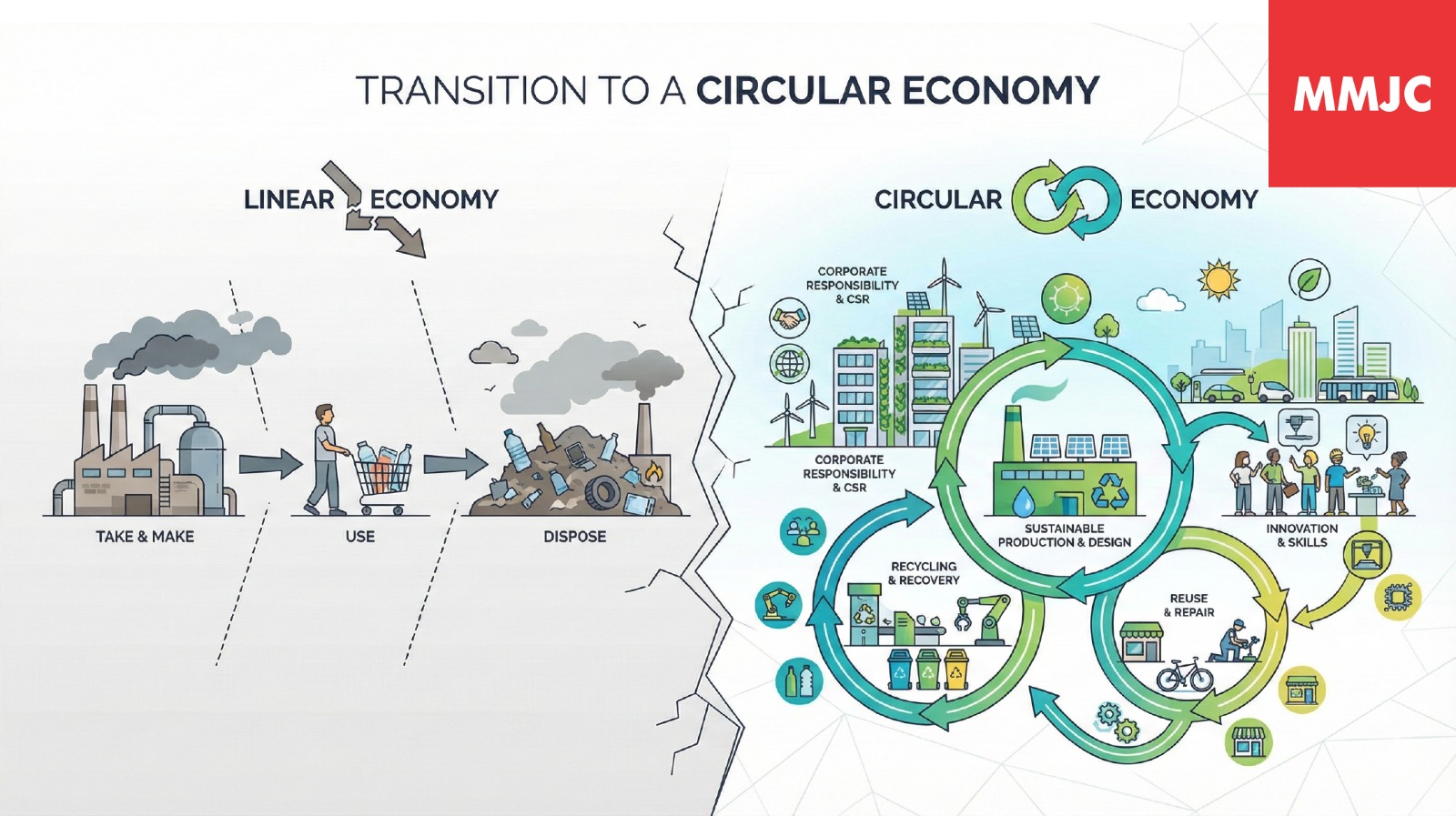
In the context of these global and local efforts, it becomes essential to rethink how we use natural resources. As waste generation rises and natural resources shrink, the traditional “take–make–dispose” model—where raw materials are consumed, products are made, used, and then discarded—is proving unsustainable. This linear approach creates huge amounts of waste and puts extreme pressure on already limited resources.
Scale of the problem:
The World Bank in its What a Waste 2.0 report (2018), highlights the scale of this challenge. At least 33% of the 2.01 billion tonnes of municipal solid waste (2016) generated globally, was either dumped or burned, leading to air pollution, greenhouse gas emissions, and public health issues. The waste generation is expected to reach 3.40 billion tonnes by 2050. While plastic waste accounted for 242 million tonnes, it was not alone. Food loss and resource waste across the supply chain added to methane emissions.
To overcome these issues, the circular economy offers a practical and effective alternative. A circular economy keeps products and materials in use for as long as possible through reuse, repair, recycling, and recovery. This reduces the need for new resources, lowers environmental impact, cuts waste, and creates new economic and employment opportunities.
Despite these benefits, progress remains slow. The Circularity Gap Report 2020 shows that only 8.6% of the global economy is circular, meaning over 90% of extracted resources ultimately become waste. This highlights the urgent need for more efficient resource use and better waste reduction systems. Some of the challenges to adopting circularity include:
Inadequate infrastructure for waste segregation, collection, and recycling, making it difficult for municipalities and waste-management authorities to implement circular practices effectively.
High initial investment for technologies and redesigned products, a major barrier for industries and manufacturers.
Low awareness: Many consumers, retailers, and businesses still follow the linear “use-and-dispose” mindset, slowing the adoption of circular behaviours.
Recognizing these challenges, global initiatives are gaining momentum. The European Union aims to double its circular material use rate by 2030 and is working on a new Circular Economy Act to improve access to recycled materials and reduce biodiversity loss linked to resource extraction.
India, too, has taken strong steps toward circularity across national missions. Circular approaches help conserve resources, cut emissions, and reduce landfill waste. They also create green jobs, drive innovation in sustainable product design, and support long-term economic growth by keeping materials in circulation for longer.
India’s Key Circular Initiatives Include:
Given this policy push, corporates have a critical role in accelerating the transition. Companies should prioritize circular economy to save money by improving efficiency and reduced waste. By adopting these practices, businesses can also avoid future environmental penalties, meet government rules, and build a good reputation with customers and investors who prefer responsible brands.
Practical Circular Economy Actions Corporates Can Adopt
Investing in R&D and Innovation – Companies can collaborate nationally and internationally to develop new technologies that convert hard-to-recycle plastics into useful, durable products. This creates value from materials that would otherwise go to landfills and also encourages the replacement of virgin materials with recycled alternatives.
Adopting Zero-Waste Processing Practices – Using environment-friendly recycling and processing methods that minimize emissions and residues ensures safer, cleaner operations. Low-impact, zero-waste technologies strengthen corporate sustainability goals and reduce regulatory and compliance risks.
Strengthening Circular Supply Chains – Corporates can build closed-loop systems by sending their plastic or industrial waste to recycling partners and receiving recycled products in return. They can also set up small, local circular economy centres near project sites to support waste collection, processing, skill development, and product manufacturing—creating long-term social and environmental impact.
Supporting Community-Based Waste Collection – By partnering with local communities, schools, and SHGs, companies can promote responsible waste segregation and collection, ensuring a steady flow of recyclable materials. Corporates can further demonstrate leadership by using recycled boards, panels, furniture, and other materials in their offices, factories, CSR projects, and community infrastructure—showcasing their commitment to reducing carbon footprint.
Skilling and Training – Corporates can invest in training workers and community members in recycling practices, waste management, and circular economy skills, building a capable workforce that supports long-term sustainability.
By adopting circular economy practices, companies can help protect the environment, save costs, create new green jobs, and strengthen their business for the future. The shift may be difficult, but with strong commitment from corporates, it becomes a chance to build a more sustainable and fairer world for everyone.
The article is written by Ms. Suhani Thepadiya – Sustainability Consultant