October 30, 2025


Introduction:
Over time, carbon credits have become an important tool in tackling climate change. First introduced under the Kyoto Protocol and later strengthened by the Paris Agreement, carbon credits represent verified reductions in greenhouse gas (GHG) emissions. In line with its global climate commitments, India has updated its targets to reduce GHG emissions by 45% by 2030 compared to 2005 levels and aims to reach net-zero by 2070.
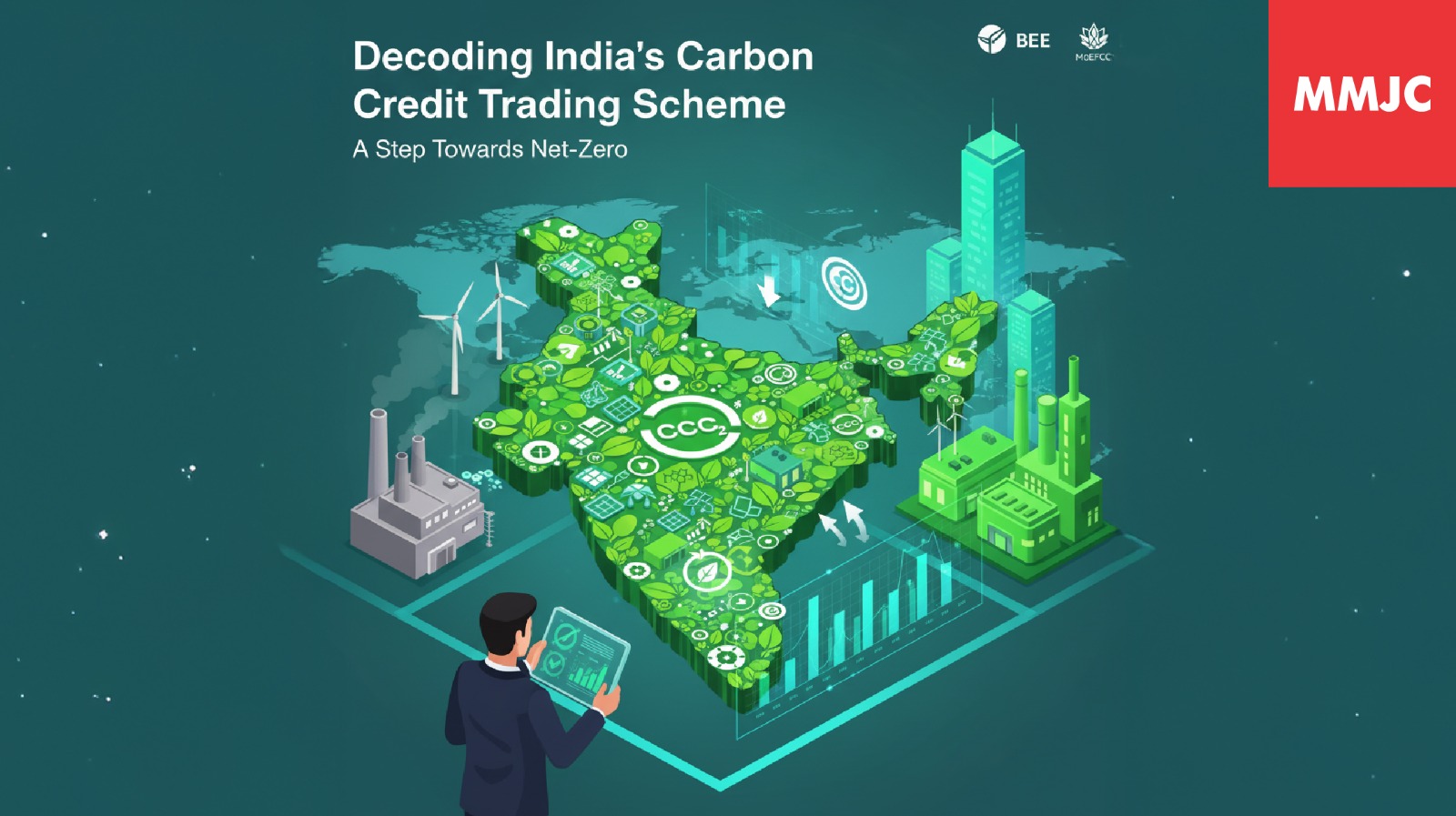
India’s Perform, Achieve and Trade (PAT) scheme successfully improved energy efficiency in industries for over years. However, to meet its bold climate goals, India needed to focus more directly on cutting greenhouse gas (GHG) emissions. To support this, the Energy Conservation (Amendment) Act, 2022, introduced the Carbon Credit Trading Scheme (CCTS). This marked a shift from just promoting energy savings through Energy Saving Certificates to creating a real carbon market where Carbon Credit Certificates (CCCs) can be traded for proven reductions in GHGs helping India move closer to its net-zero targets.
This scheme sets up a formal carbon market in India, managed by the Bureau of Energy Efficiency (BEE), the Grid Controller of India, and the Central Electricity Regulatory Commission (CERC). Under the scheme, selected industries must meet yearly emission targets or buy CCCs if they exceed their limits.
This article explains the two types of carbon markets under the CCTS Compliance and Voluntary and how they support India’s shift towards a low-carbon future.
What are Carbon Markets:
Carbon markets are systems that enable the buying and selling of carbon credits each credit representing a verified reduction or removal of one metric tonne of carbon dioxide equivalent (CO₂e) from the atmosphere.
These markets serve dual purposes:
By attaching a price to carbon, these markets turn climate action into a measurable, tradeable, and accountable outcome giving both public and private actors a stake in achieving net-zero goals.
There are two main types of carbon markets:
The Carbon Credit Trading Scheme (CCTS), 2023, has been developed by the Indian government to align with the country’s industrial needs and climate ambitions. It brings together both compliance and offset mechanisms to support economy-wide efforts to reduce carbon emissions.
Compliance Mechanism under the Carbon Credit Trading Scheme, 2023:
The Compliance Mechanism under the CCTS forms a foundation for the India’s regulated carbon market. It operates on an intensity-based baseline-and-credit model wherein the obligated entities are assigned with specific GHG emission intensity target.
Entities that reduce their emissions below the set target are awarded with Carbon Credit Certificates (CCCs). Each CCC representing one tonne of CO2 equivalent emission reduction or removal. On the other hand, entities that do not meet their assigned targets must purchase an equivalent number of Carbon Credit Certificates (CCCs) from the market to make up for the shortfall. This creates a financial incentive to reduce emissions.
The Compliance mechanism initially covers entities from key energy-intensive industrial sectors which were previously part of PAT scheme. These are as follows:
The obligated entities under these sectors are notified with the mandatory GHG emissions intensity target the obligated entities under these sectors are notified with the mandatory GHG emissions intensity targets for a multi-year trajectory period, subject to regular review. Non-compliance is met with penalties to ensure the effectiveness of the scheme. The Central Pollution Control Board (CPCB) is responsible for imposing financial penalties on entities that fail to surrender the required number of CCCs. The penalty is set at an amount equal to twice the average market price of the carbon credits during the relevant trading period. This penalty structure is designed to be a significant financial deterrent, making it more cost-effective for entities to invest in decarbonization or purchase credits rather than face the penalty.
Voluntary Mechanism under the Carbon Credit Trading Scheme, 2023:
In addition to the compliance mechanism, the CCTS also provides for a voluntary or offset mechanism. This is a crucial feature that expands the reach of the carbon market beyond the specified obligated entities. The voluntary market allows non-obligated entities such as companies not falling under the designated sectors, municipalities, and even individuals to participate in climate action.
Under this mechanism, these non-obligated entities can undertake projects that lead to verifiable GHG emission reductions, removals, or avoidance. Once a project is approved and its reductions are verified by an accredited agency, it can be issued CCCs. These CCCs can then be sold to obligated entities in the compliance market, creating a flow of funds that incentivizes and finances a broader range of climate projects. This dual-market approach ensures that a wider range of sectors, including renewable energy, afforestation, green hydrogen production, and waste management, can contribute to India’s overall climate goals. The CCTS also introduces specific methodologies for measuring and verifying these projects to ensure the integrity and quality of the credits generated.
Institutional Framework and Governance under CCTS, 2023:
The successful operation of the CCTS relies on a robust institutional framework. The Ministry of Power and the Ministry of Environment, Forest and Climate Change (MoEFCC) are the key ministries overseeing the scheme. The primary managing bodies are:
Opportunities and Challenges of CCTS, 2023:
The CCTS offers significant opportunities but also faces considerable challenges. The opportunities include a powerful financial incentive for decarbonization, the mobilization of private capital for climate-friendly projects, a key policy tool for achieving climate goals, and positioning India as a leader in carbon markets. However, the challenges are equally significant. These include ensuring market liquidity and preventing price volatility, establishing a robust and transparent Monitoring, Reporting, and Verification (MRV) system to prevent greenwashing and double counting, overcoming inadequate technical expertise in smaller industries, and ensuring the ambition of targets is sufficient to drive real change.
Way Forward and Recommendations:
To ensure the long-term success of the CCTS, a strategic and phased approach is essential. The government can start by strengthening Monitoring, Reporting, and Verification (MRV) systems with the use of robust digital infrastructure to ensure data transparency and accuracy. It should also prioritize capacity building by launching training programs for industry players, particularly for Small and Medium-sized Enterprises (MSMEs) to help them understand and comply with MRV requirements. Furthermore, exploring market linkages with international carbon markets is crucial to enhance liquidity and enable better price discovery for credits. The policy should evolve by gradually tightening emissions intensity targets over time, which would ensure alignment with India’s Nationally Determined Contributions (NDCs). Active private sector engagement should be encouraged through incentives that prompt corporations, financial institutions, and startups to participate actively in the voluntary carbon market. Finally, promoting awareness and public participation among smaller stakeholders and the general public can build a broader culture of low-carbon transition, making the scheme a truly nationwide effort.
Conclusion:
The Carbon Credit Trading Scheme (CCTS), 2023, is a key step in India’s transition to a low-carbon economy. By combining compliance and voluntary mechanisms, it compels large emitters to decarbonize while encouraging participation from businesses and individuals. Its institutional framework and market-based approach enable innovation and accountability, aligning with India’s climate commitments.
Challenges like market liquidity, greenwashing risks, and MSME capacity need attention, but with strong MRV systems, tighter targets, and active participation, the CCTS can position India as a global carbon market leader and accelerate progress toward its 2030 and 2070 climate goals.
This article is written by Ms. Samiksha Gada- Consultant- ESG